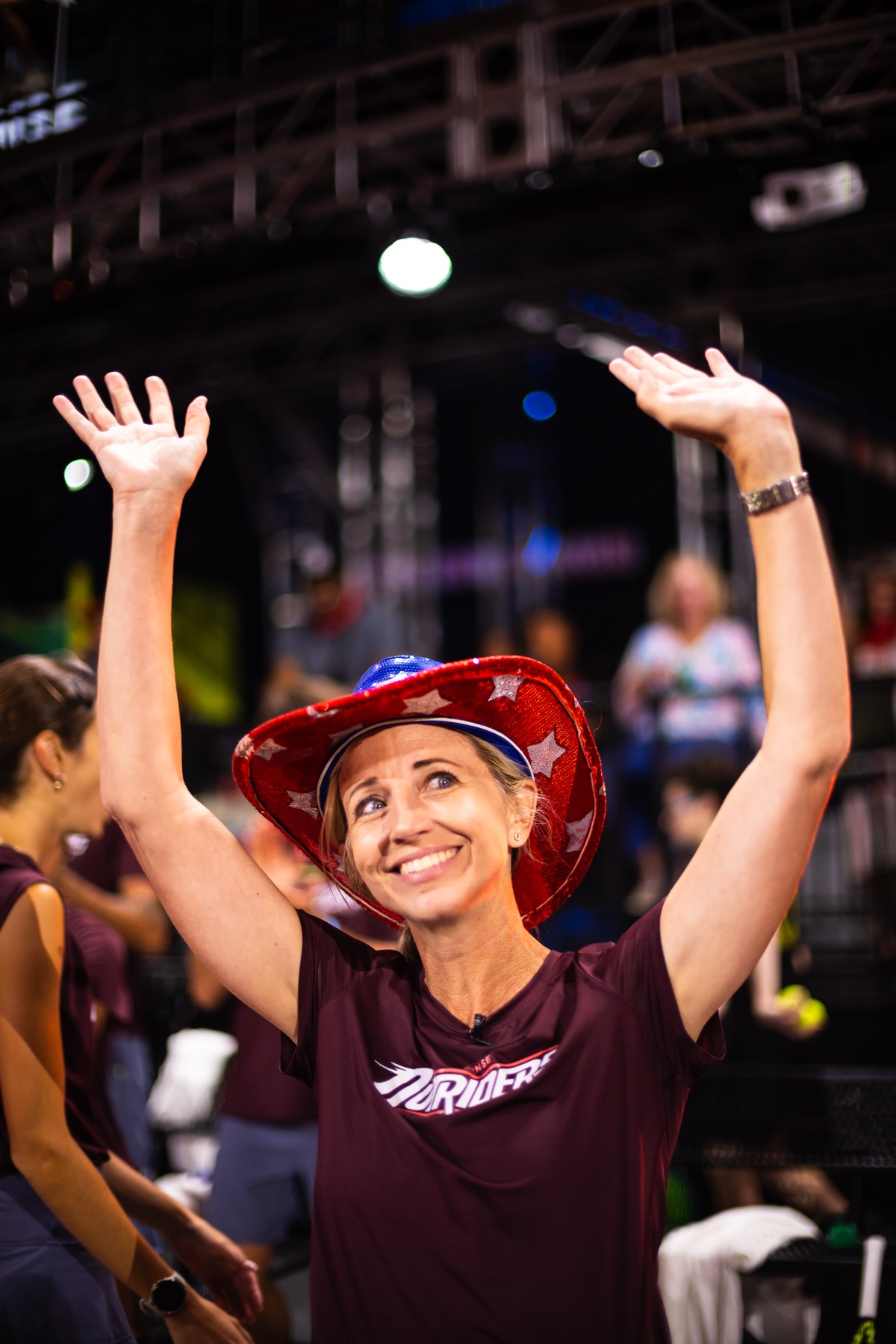
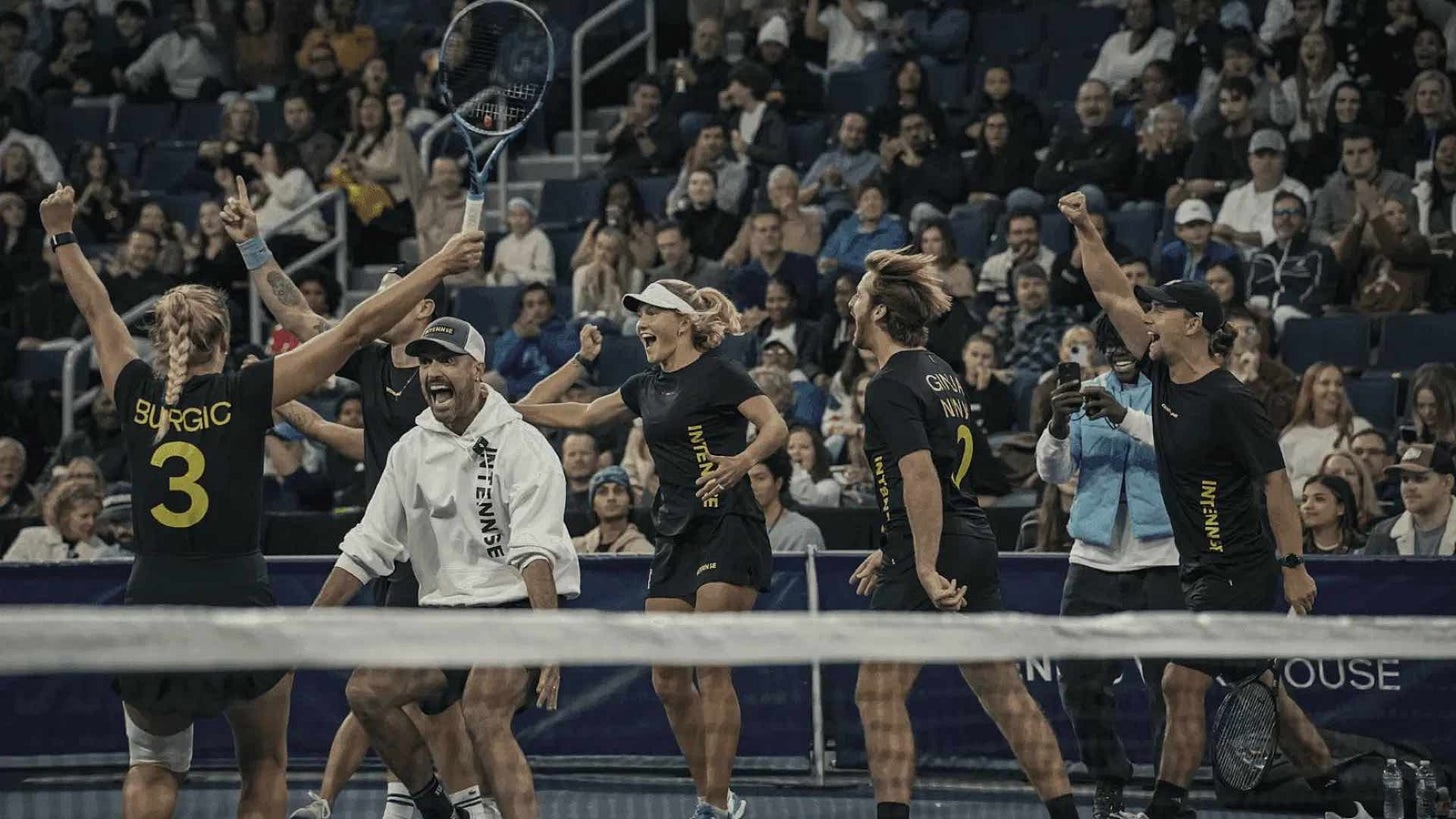
You are building professional tennis for American women a week at a time, on campuses, with a WTA sanction. This is the other half of the same idea — a season, a salaried roster, and a city that keeps the team after the event is over. The territory is Broward–Palm Beach.
A team charter · about five minutes
“This one you can have fun.” — in the stands, Atlanta
A gender-balanced Professional Team Tennis League
Eight playing weeks in the middle of the summer. Switch the view to see the
same season against the American sports year, or against the college calendar our players come from.
INTENNSE Grand Slams Team events
INTENNSE Regular season Postseason
INTENNSE Regular season Postseason & championships
2026 season. INTENNSE: 5 June – 1 August, 58 days, one dark week for Wimbledon. Sources: data.intennse.com/2026/calendar.tsv; published tournament calendars.2026 calendar year. The NBA and NHL finished on 13 and 14 June; the NFL’s season opens 9 September; LOVB ran January to April. Only MLB is in season through INTENNSE’s eight weeks. Sources: published league calendars; INTENNSE figures from data.intennse.com.NCAA Division I, 2026 as it happened. Both the men’s and the women’s team championships finished on Sunday 17 May at the Dan Magill Tennis Complex in Athens, Georgia — Virginia over Texas, Texas A&M over Auburn. The NCAA has moved singles and doubles out of May: they are now a November event, so a graduating senior has nothing left on the college calendar at all. Basketball’s season opened in November 2025; the January football block is the 2025 season’s playoff. D-I carries 5,207 tennis players across 541 programmes. Sources: ncaa.com championship releases, official school schedules, NCAA Sports Sponsorship and Participation Rates Report 2024–25.
Where our players have been on the tour, and where they sit on the rating that
covers everyone. The orange rule is where tennis starts paying for itself.
Career high September 2026MVP race ↗ (second scale) alone = no tour ranking, placed by MVP standingName in yellow = straight from college
Rounds 1–3 of the 2026 draft, plus three players the draft board leaves out altogether and one fourth-round pick: 56 in all. Forty-seven carry an ATP or WTA career high. The nine below the dotted line in each panel have no tour ranking on record and are placed by where they finished in the league’s own MVP race — among them Sofia Cabezas, fifth in that race, and Corey Craig, thirteenth, straight out of Florida State. Two more carry a career high but no current singles ranking, so they show a career-high dot alone. Fourth-round picks are otherwise excluded — 2027 rosters are three women and three men. The one exception is John Chin, 19th of 31 men over four Arcs, ahead of eight higher picks including two first-rounders. A player placed by MVP standing needs more than one Arc behind the number: Season Score is the sum of a player’s best six rounds divided by six, so a single appearance is not a season. Ranking axis runs worst to best, left to right, as in the UTR chart below. The MVP race is a separate scale, and it stops at our own best-ranked player rather than running the width of the chart — it ranks these players against each other inside the league, not against the tour. Aliona Bolsova sits inside that line on both counts: a career high of 88, inside a Grand Slam draw, and first in the 2026 MVP race. A career high is never drawn worse than the player’s current ranking: where a recorded best is stale, the best is at least today’s rank and the two collapse to a single point. Tier cut-offs: main draw top 128 — the draw size of a Grand Slam — Challenger 129–350, ITF Futures 351–900 (the ITF renamed the Futures circuit the World Tennis Tour in 2019). The orange rule is the break-even ranking — where prize money covers the cost of competing. It is drawn at ~150, which is where a peer-reviewed 2026 study puts it once a realistic cost base including a coach is counted — and every professional has a coach. The faint rule behind it is the ITF’s own 2013 figure, 336 for men and 253 for women, which sits at a worse ranking only because those costs exclude coaching and all support-team expense. It is the bar nobody actually competes under. Against the real bar: of the 26 men here with a career high, all 26 never reached 150; of 21 women, 19 never did — the exceptions are Aliona Bolsova at 88 and Usue Arconada at 130. On today’s rankings it is unanimous: 25 of 25 ranked men and 20 of 20 ranked women sit outside break-even. Sources: draft.intennse.com, stats.intennse.com MVP race, intennse.com player pages, Tennis Abstract, retrieved 20–21 September 2026; ITF Pro Circuit Review, Stage One: Data Analysis, December 2014; Schöttl et al., Social Sciences & Humanities Open, 29 June 2026.
UTR: our players against the tour’s
INTENNSE player Straight from collegeTop three picks per team Tour band (10th–90th percentile)
Bands derived from 286 players who publish both a UTR rating and an ATP/WTA ranking, taken at the 10th–90th percentile of each tier. INTENNSE ratings: the top three men and three women per 2026 roster — 28 men and 30 women carry a rating on the league’s own draft board. Source: draft.intennse.com players board, retrieved 20 September 2026.
Down to the wire; Sudden Death
Two Arcs that finished a point apart. Each clip picks up in the closing minutes,
with the full Arc a click away.
Sudden death, level at 142
The final three minutes of Freeze v Rise, 20 June. The clock runs out with the teams tied, and the next point decides it: 143–142.
3.59MBroward and Palm Beach — more than Miami-Dade
8 wksJune to August, a salaried roster
6On court for every team — three women, three men
10 yrsThe charter term, renewing in fives
■ Your own words
“Tennis is full of women who can go toe-to-toe with anyone in the world and still walk
away beaten not by an opponent, but by the cost and chaos of chasing the tour
overseas.”
Nicholas Konjevic · American Tennis Circuit · 18 June 2026
That is the best sentence written about this problem
by anyone this year, and it is yours. We agree with all of it, and we have built the other half
of the answer. A draw pays the people who win. A roster pays everyone, every week,
whether they win or not.
That is the whole difference between a tournament and a team, and it is the
difference between a player who can afford to keep going and one who quietly stops. Players here
are employees on a base wage with league coaching, for an eight-week season, in one city.
■ The other half of the year
Your event is a week in November. Ours is a season in the summer.
The American Tennis Open Miami runs 2–8 November
— a WTA 125, $125,000, a 32 draw, at the Neil Schiff Tennis Center in Coral Gables. At
that purse it is the only WTA 125 in the United States paying above the tier
standard. INTENNSE runs June to August.
They do not collide on the calendar, and they do not collide for players.
A woman can play a WTA 125 on a campus in November and be on a salaried roster the
following summer — which is two more months of paid tennis in a year that otherwise
asks her to fund herself.
A Friday night in the Arena
■ Broward–Palm Beach
The territory runs through your own office.
Broward and Palm Beach counties together hold 3.59 million
people — more than Miami-Dade. Their NHL team has won back-to-back Stanley Cups.
Tennis runs the length of it, from Fort Lauderdale to Boca to Delray, where an 8,200-seat stadium
has hosted professional tennis since 1999. Boynton Beach sits in the middle of it.
3.59MBroward 2.01M and Palm Beach 1.58M, 2025 Census
estimates.The territory
6.39MMiami–Fort Lauderdale–West Palm Beach, the eighth-largest
metro in the country.The region
Nielsen, this monthWest Palm Beach and Miami both sit in the top four of the
tennis-market index Nielsen published in September 2026.The fandom
The derbySmash and Sting, one highway apart. The rivalry exists before the
team has played a home match.Built in
■ The team today
A roster that beats champions.
In July, Smash beat the eventual 2026 champions, Freeze, 177–139
— one of only three teams to beat them all season — and finished the year having
scored more points than it conceded.
Head coach Sofia Rachi was raised in Miami, where her
parents have run a tennis academy since she was nine, and now leads the women’s
programme at North Carolina Central. Adriana Reami was born and raised in
Miami before starring at NC State. Dalayna Hewitt led the team in scoring.
Benjamin Lock was an All-American at Florida State.
Three women, three men, one score
■ How it plays
One shared score, about an hour and forty minutes.
Three women and three men on court for every team, and every point counts the
same whoever wins it. The scoreboard never resets, so the finish is rarely settled early —
two Arcs last season were decided by a single point. Forty-three Pro Arcs in 2026, sixty-five in
2027, every one carried live.
A woman’s point is worth exactly what a man’s point is worth. That is
the format rather than a policy, and it is the reason the women on these rosters are watched by
the same crowd, on the same court, at the same time as the men.
■ The path to owning it
A ten-year charter for Broward–Palm Beach.
Owners hold an exclusive Team Charter — MLS-style, geographically bound
economic rights rather than a traditional franchise. Ten years, renewing in five-year terms.
The league keeps
Game — format, rules, schedule,
officiating.
Brand — league marks and national sponsorship.
The owner holds
Team — operations and team marks in the
territory.
Revenue — local sponsorship, ticketing, hospitality,
activations.
Share — team merchandise, and a share of pooled league
revenue.
2026–27The league operates the team while South Florida events build
its audience.Now
2028Smash moves home. The owner appoints a GM, takes ticketing, hospitality
and venue, and inherits a community playbook proven over three
years.Home
2029 onScale — and a share of the fees from every charter the league
sells after the initial offering.Upside
■ Why we sent this
You are already building the thing this sits next to.
Most people we talk to have to be convinced that American women need somewhere
to play at home and get paid for it. You have spent money proving you believe it — a WTA
sanction is genuinely hard to get and you are paying above the tier standard to run one.
This is the part your circuit cannot reach: the weeks between the tournaments,
a salary rather than a purse, and a city that keeps the team when the event is over. If it is
worth an hour, we will bring the charter, the economics, and what the 2028 move looks like in
detail.